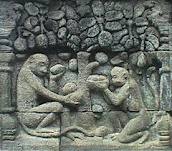
It was while staying in Savatthi that the Buddha told
this story to encourage a disheartened bhikkhu to persevere so that he would
have no regrets in the future. "If you give up your practice in this
sublime teaching which leads to Nibbana," the Buddha told him, "you
will suffer long, like the trader of Seriva who lost a golden bowl worth one
hundred thousand cons."
When asked to explain, the Buddha told this story of the
distant past.
Five eons ago, the Bodhisatta was an honest trader
selling fancy goods in the kingdom of Seriva. Sometimes he travelled with
another trader from the same kingdom, a greedy fellow, who handled the same
wares.
One day, the two of them crossed the Telavaha River to do
business in the bustling city of Andhapura. As usual, to avoid competing with
each other, they divided the city between them and began selling their goods
from door to door.
In that city, there was a ramshackle mansion. Years
before, the family had been rich merchants, but, by the time of this story,
their fortunes had dwindled to nothing, and all the men of the family had died.
The sole survivors were a girl and her grandmother, and these two earned their
living by working for hire.
That afternoon, while the greedy peddler was on his
rounds, he came to the door of that house, crying, "Beads for sale! Beads
for sale! Beads for sale!
When the young girl heard his cry, she begged,
"Please buy me a trinket, Grandmother."
"We're very poor, dear. There's not a cent in the
house, and I can't think of anything to offer in exchange."
The girl suddenly remembered an old bowl.
"Look!" she cried. "Here's and old bowl. It's of no use to use.
Let's try to trade it for something nice."
What the little girl showed her grandmother was an old
bowl which had been used by the great merchant, the late head of the family. He
had always eaten his curries served from this beautiful, expensive bowl. After
his death, it had been thrown among the pots and pans and forgotten. Since it
hadn't been used for a very long time, it was completely covered with grime.
The two women had no idea that it was made of gold.
The old woman asked the trader to come in and sit down.
She showed him the bowl and said, "Sir, my granddaughter would like a
trinket. Would you be so kind as to take this bowl and to give her something or
other in exchange?
The peddler took the bowl in his had turned it over.
Suspecting its value, he scratched the back of it with a needle. After just one
covert look, he knew for certain that the bowl was really made of gold.
He sat there, frowning and thinking, until his greed got
the better of him. At last, he decided to try to get the bowl without giving
the woman anything whatever for it. Pretending to be angry, he growled,
"Why did you bring me this stupid bowl? It isn't worth even one
cent!" He threw the bowl to the floor, got up, and stalked out of the
house in apparent disgust.
Since it had been agreed between the two tradersthat the one might try the streets which the
other had already covered, the honest peddler came later into that same street
and appeared at the door of the house, crying, "Beads for sale!"
Once again, the young girl made the same request of her
grandmother, and the old woman replied, "My dear, the first peddler threw
our bowl on the ground and stormed out of the house. What have we got left to
offer?"
"Oh, but that trader was nasty, Grandmother. This
one looks and sounds very kind. I think he will take it."
"All right, then. Call him in."
When the trader came into the house, the two women gave
him a seat and shyly put the bowl into his hands. Immediately recognizing that
the bowl was gold, he said, "Mother this bowl is worth one hundred
thousand coins. I'm sorry, but I don't have that much money."
Astonished at his words, the old woman said, "Sir,
another peddler who came here a little while ago said that it was not worth
anything. He got angry, threw it on the floor, and went away. If it wasn't
valuable then, it must be because of your own goodness that the bowl has turned
into gold. Please take it, and just give us something or other for it. We will
be more than satisfied.
At that time, the peddler had only five hundred coins and
goods worth another five hundred. He gave everything to the women, asking only
to keep his scales, his bag, and eight coins for his return fare. Of course,
they were happy to agree. After profuse thanks on both sides, the trader
hurried to the river with the golden bowl. He gave his eight coins to the
boatman and got into the boat.
Not long after he had left, the greedy trader returned to
the house, giving the impression of having reluctantly reconsidered their
offer. He asked them to bring out their bowl, saying that he would give them
something or other for it, after all.
The old woman flew at him. "You scoundrel! she
cried. "You told us that our golden bowl was not worth even one cent.
Lucky for us, an honest peddler came after you left and told us that it was
really worth one hundred thousand coins. He gave us one hundred thousand coins
for it and took it away, so you are too late!"
When the trader heard this, an intense pain swept over
him. "He robbed me! He robbed me! he cried. "He got my golden bowl
worth one hundred thousand coins!" He became hysterical and lost all control.
Throwing down his money and merchandise, he tore off his shirt, grabbed the
beam of his scales like a club, and ran to the riverside to catch the other
trader.
By the time he got to the river, the boat was already in
midstream. He shouted for the boat to return to shore, but the honest trader,
who had already paid, calmly told the ferryman to continue on.
The frustrated trader could only stand there on the
rive-bank and watch his rival escape with the bowl. The sight so infuriated him
that a fierce rage welled up inside. His heart grew not, and blood gushed from
his mouth. Finally, his heart cracked like the mud at the bottom of a pond
dried up by the sun. So intense was the unreasoning hatred which he developed
against the other trader because of the golden bowl that he perished then and
there.
The honest trader returned to Seriva, where he lived a
full life spent in generosity and other good deeds and passed away to fare
according to his deserts.
Having
concluded his story, the Buddha identified the birth: "At that time,
Devadatta was the greedy trader, and I was the honest trader. This was the
beginning of the implacable grudge which Devadatta has held against me through
innumerable lives."
We need to educate for Happy & Simple New Generations
Farewell & Honoring certificate of Analytical Dhamma Vibhijja English Class in Meiktila, 31.7.2012
Every body in the world has been facing many
diseases. All diseases can be briefly divided into two parts. They are physical
disease and psychical disease. To treat the physical disease, we need medicines.
For psychical disease, we need lots of things.
In this case, the Buddhist culture can help a
lot. Buddhist psychotherapy is included in the Buddhist culture. Buddhist
psychotherapy is a system of treating for mental patients. Mental illnesses can
be cured by this method. And Buddhist psychotherapy can be also practiced as
complementary to existing western psychological methods. The Buddhist culture
has many aspects such as observance of precepts, Bodhipūjā, reading Jātaka
stories, reciting Paritta, transference of merits, rejoicing in others’
meritorious deeds, ten meritorious deeds, astrology, preaching dhamma, listening
to the dhamma, and rituals, etc.
Among them, I’d like to discuss
about Bodhipūjā as an example. Bodhipuja is a Pali word. It is combined two
words as Bodhi and Puja. The word, Bodhi means a kind of tree. The Pali word of
Puja means paying respect to the Bo-tree. Some says as Bodhi-tree. It is said
that there are three Bo-trees. The original Bo-tree is located in Bodh Gaya in
the Indian state of Bihar. The Buddhist texts
state that the Buddha, after his Enlightenment, spent a whole week in front of
the tree, standing with unblinking eyes, gazing at it with gratitude.
Next Bo-tree is Anandabodhi tree
in Sravasti(Pali in Savatthi). In order to make people’s offerings in the name
of the Buddha when the Buddha was away on pilgrimage, he allowed the planting
of a seed from the Bodhi tree in front of the gateway of Jetavana Monastery
near Savatthi. For this reason Venerable Mahamoggallana took a fruit from the
tree as it dropped from its stalk, because it reached the ground.
Anathapindika, a rich donor of Jetavana monastery, planted it in a golden jar
with great pomp and ceremony. The Buddha spent one night under it in order to
consecrate it, and a sapling immediately sprouted forth, fifty cubits high.
This tree came to be known as the Ananda Bodhi as it was planted under the
direction of Ananda.
The third Bo-tree is Sri Maha
Bodhi. It is located in Sri
Lanka. The Mahavamsa, a great chronicle, describes
that the right branch of the Bodhi tree was brought by Therisanghamitta, a
daughter of King Asoka, a great empire of India,
and it was planted in 288 BC in Anuradhapura.
These three Bo-trees become a great significance in the history of Buddhism.
The Sri Lankan people planted many Bo-trees taking the branches from the Bodhi
tree and its seeds.
Many Bo-trees have been planting
in almost junctions and in all temples in Sri Lanka. By the way, a professor
named Sumanapala Galmangoda from Kelaniya
University in Sri Lanka said
a joke as follow; a physical hungry person goes to hotel but a mental hungry
person comes to temple. Many Sri Lankan devotees, of course, often go to the
temple. When we go to the temple, we will see first the main three objects.
They are the Buddha’s tooth relic, the Bodhi-tree, and the Buddha’s image. These
three are primary objects for veneration. Some criticizes that it is not
useless paying respects the material objects, doing religious ceremonies, and
rituals.
A famous book named “Buddhism in
nutshell” written by Venerable Narada Mahathera describes with regard to rituals
as follow; “the Bo-tree is also a symbol of Enlightenment as the Buddha has
achieved the supreme enlightenment under the Bo-tree. These external objects of reverence are not
absolutely necessary, but they are useful as they tend to could dispense with
them as he could easily focus his attention and visualize the Buddha.
For our own good, and out of
gratitude, we pay such external respect but what the Buddha expects from his
disciples is not so much obeisance as the actual observance of his Teachings.
The Buddha says-“He honors me best who practices my teaching best. He who sees
the Dhamma sees me.”
With regard to images, however,
Count Kaiserling remarks “I see nothing grand in this world then the image of
the Buddha. It is an absolutely perfect embodiment of spirituality in the
visible domain.”
Venerabel Walpola Rahula, a
famous author of Sri Lanka,
explained like that “of course there are in all Buddhist countries simple and
beautiful ceremonies on religious occasions. There are shrines with statues of
the Buddha, stūpas or Dāgābas and Bo-tree in monasteries where
Buddhists worship, offer flowers, light lamps and burn incense. This should not
be likened to prayer in theistic religions; it is only a way of paying homage
to the memory of the Master who showed the way. These traditional observances,
though inessential, have their value in satisfying the religious emotions and
needs of those who are less advanced intellectually and spiritually, and
helping them gradually along the Path.”
Let’s go back what I have early
discussed. As soon as we got under the Bodhi-tree, we felt cool. By paying
respect it we come to remember glories of the Buddha. At that time, we have
already developed Buddhānussati. Besides, we can develop the Buddhānussati like
that “the Buddha is holy person, a fully Enlightened one, perfected in wisdom,
etc. Furthermore, we can develop dhammānussati and Sanghānussati, etc. By
developing them, we get much meritorious deeds. And we feel calm, peaceful and
quiet. This behavior would not disturb any others. If we transfer our merits
for others, they will be happy.
Meanwhile, we can observe the
precepts and recite Paritta. Similarly, when we sweep or clean the dirty places,
many people will also appreciate it. So we will get much merit. These motion
activities provide us to be good for physical disease. The cleaning environment
also provides to prevent from many diseases.
Afterwards, we will feel cool and
fresh by offering water. For another thing, we will be highly pleased by offering
the beautiful flowers. The beautiful Flowers make us fond. Later, the flowers
will be languid naturally. They then
will gradually fade and wither. By
seeing it we come to understand the nature of impermanence. Then, suffering and
non-self will be understood little by little. Bodhipūjā is indeed based on morality,
concentration, and wisdom.
Knowing these three
characteristics is very useful to get Nibbāna. Venerable Narada explained with
regard to Nibbana in his book as follow; “The Pali word Nibbana is formed of Ni
and Vana. Ni is a negative particle and Vana means lusting or craving. It is
called Nibbana, in that it is a departure from the craving which is called
Vana, lusting. Literally, Nibbana means non-attachment. It may also be defined
as extinction of lust, hatred and ignorance. Nibbāna is final destination in Buddhism. Thus,
we come to reduce greed, hatred and ignorance. We can examine our bodies,
feelings, minds and thoughts depending on these three characteristics. When we
attain Nibbāna, all physical diseases and psychical diseases will disappear. At
that time mental health can be fully achieved. Buddhism emphasizes that “Health
is the highest gain”. So, Buddhist
culture is real psychotherapy for all. The Buddhist psychotherapy can eliminate
not only physical disease but also psychical disease. So, Bodhipūjā is very
important as far as Buddhist psychotherapy.
Reference:
What the Buddha taught by Walpola Rahula,
Buddhism in nutshell by Venerable Narada Thera,
Buddhist Psychotherapy by
MSS Nissanka, MA (Pitts.) Ph.D (Jadv),
Jatakatthakatha.4.228,
2010,Psychotherapy lectures from Kelaniya
University in Sri Lanka,